It is so sad when we remember how our Families in Kenya went through hell during the first phase of COVID-19. Many of our own residing in the poor urban areas suffered from hunger since they were not able to meet their obligations of putting food on the table. To help overcome this, the Kenyan government developed relief programs across the country. The Kenyan government partnered with other agencies including the world food program (WFP) to try achieve this.
With the help of WFP, the government rolled out aid to over 400,000 families across the country. Most of these families where in the Nairobi and the coastal town of Mombasa. COVID-19 flourishes and spreads quickly in overcrowded metropolitan areas with insufficient sanitation. The Kenyan government strived hard to meet the united nations development goals of eradicating poverty in the world with the target of, ensuring significant mobilization of resources from a variety of sources, including through enhanced development cooperation, in order to provide adequate and predictable means for developing countries, in particular least developed countries, to implement programs and policies to end poverty in all its dimensions.
This program helped a lot of families living in these slums areas in Nairobi and Mombasa but many where left out. World Food Program spokesperson Tomson Phiri said that many more people who have lost jobs and income due to the pandemic need aid. However, he noted that WFP does not have the money to help them. He said that the agency’s $64 million emergency appeal is only 36% funded. With adequate international support, WFP could be able to provide food assistance to 725,000 needy people in Nairobi’s informal settlements and other hotspots.
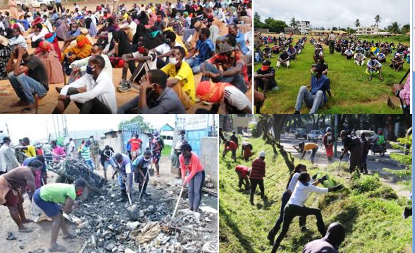
The Kazi Mtaani Programme is an initiative that was designed to support the youths in the informal settlements from the effects of COVID-19 pandemic. The programme also acted as a standing stone for many of the youths in the poor state. The objective of the programme was to provide a form of social protection for workers whose prospects for daily or casual work was been disrupted by the containment policies put in place to limit the spread of COVID-19. Through this initiative, residents were recruited to undertake projects concentrated in and around informal settlements with the aim of improving the environment, service delivery and providing income generation opportunities.
Recruits in Kazi Mtaani Programme
The State Department for Youth Affairs was implementing the training component of Kazi Mtaani Programme in the 47 Counties to equip youth with industry relevant skills to ensure they are employable and productive post COVID – 19 Crisis.Generally, the programme mostly focused on eradicating poverty in the less fortunate in our communities.
Residents of various counties embarking on the Kazi Mtaani Programme
It was expected that after the training the youth would develop a saving culture, form and register groups, establish social enterprises and apply for funding from Government Affirmative Funds (YEDF, NGAAF, Women Enterprise Fund and Uwezo Fund). So far, over 200,000 youth have been trained on Entrepreneurship, Financing for business, Life Skills, Citizenship and National Values.
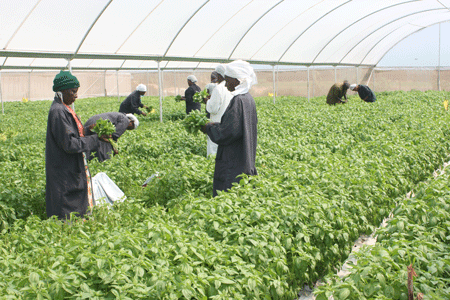
Agribusiness is a combination of agriculture and business, where the farmers take part in selling their excess produce from their farms. The Kenyan government has kept encouraging its citizens to make use of their lands by the application of irrigation mechanisms or depend on the rain to grow different crops either subsistence or cash crops in order to sustain their lives. Agriculture plays a vital role in the rural economy as it the major source of income; contributing two percent of the Gross Domestic Product (GDP). Studies show that 70% of the population of Kenya is in rural areas and agriculture has employed 40% of the population living in rural areas.
Workers in kericho
In the whole country, agriculture takes the lead in income generation and provision of employment opportunities to Kenyan citizens. The counties depending on irrigation schemes such as Wajir are developing step by step as agribusiness not only leads to food security but also generation of income that helps them improve their lives. Therefore, this assists to afford the basic needs.
Irrigation in wajir
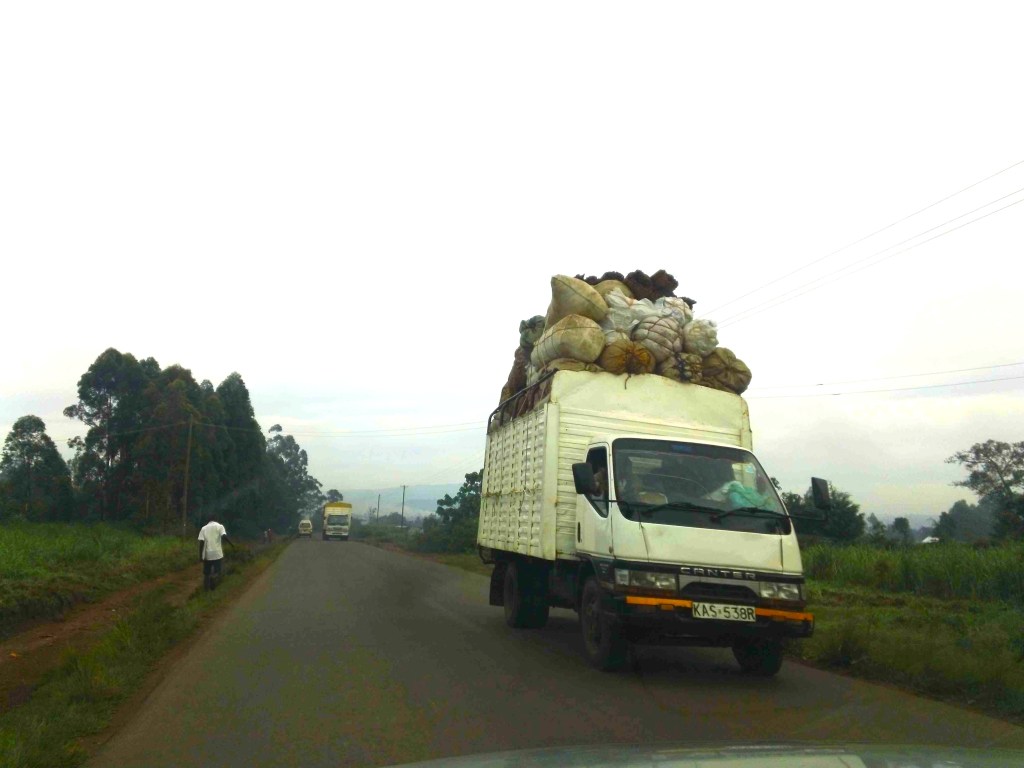
During the COVID 19 period, the sector that was not affected and rather served a very key role was the agribusiness. During and after the curfew and lockdown, those people supplying agriculture produce were not limited. They kept on supplying their products locally and also to different counties. The agribusiness played a key and significant role in ensuring that Kenyans did not face hunger during the pandemic. The Kenyan government should keep on improving the agriculture sector by creating awareness on the goodness of agriculture and making use of the land, providing modernized farming mechanisms and also standardizing the food prices in Kenya. Lastly, it should promote the local farmers rather than encouraging the importation of food from other countries.
A picture taken on kisii-nairobi road road of a lorry transporting vegetables during the coronavirus period
From the history view of our country it has many slums in Nairobi, some of the known slums known include Kibera, Kawangware, Mukuru, Soweto, Mathare and some parts of Dandora.
A picture of Kibera slums.
Life in slums is usually unbearable, whereby getting some of the basic social amenities is difficult. Some of the problems encountered there are poor sanitation, over population, lack of security lights, lack of proper built and equipped schools, health centres, recreational facilities and community centres. Access to social protection systems is not a guarantee but due to the urbanization the Kenyan government in corporation with the Kenya Slum Upgrading Programme (KENSUP) saw the necessity to upgrade life in the slums. The residents of various slums around the country benefited with the upgrading programme of the slums, the towns that were considered include Kisumu, Nairobi, Mavoko and Mombasa. The ministry of housing came into their rescue by starting house projects that had good floors.
House projects in Kibera
Schools were built, bridges constructed, health centres built, installation of street lights hence improving the security. The improvement of the livelihood in the slums is largely seen as a programme to eradicate poverty among the venerable people across Kenya.
Despite the improvements, the residents are still struggling to find stable jobs to sustain their families. Most of the residents depend on small scale businesses which were largely affected over the Corona Pandemic because the government put into practice the curfew, wearing of masks and also lockdowns. The growing population in the Nairobi based slums were affected immensely as the health facilities could not accommodate all of them. During the COVID 19 period the survival of the residents in the slums was not guaranteed, they not only feared the vast spread of the disease but were worried about the hospital bills since they are not covered by the insurances. Maintaining social distance was also an issue as their population is huge. Despite the COVID 19 guidelines, the slum dwellers had no option as they could stay crowded in a single room. Generally, we can conclude that the government has not yet fully implemented a programme that will ensure the slum dwellers are covered in proper and spacious housing facilities and access to better health care and frequent awareness of having health insurance. The government should intervene by offering job opportunities to their people so that they improve their lifestyles in relation to achieving no poverty by 2030.
Comrades from Moi University are preparing to cast their votes today as it was announced, 7th February 2020. Almost 40,000 students are expected to participate in the activity to elect leaders of their choice. This year’s election is the third election under the new Moi University student’s organization constitution: MUSO 2017, that emphasizes on the new leadership structure.
Earlier on the dean of students (students’ affairs) had produced an internal memo to officially announce the dates and give permission for the delegates to begin their campaigns. The posts provided include; chairman, vice chairman, secretary general, special needs and social affairs secretary.
Internal memo from the deans office
The undergraduate students are expected to start moving down to the student’s centre, conference rooms where the voting process will be conducted. For a student to become a leader in this university, there are various qualifications stated which include;
1.Must be registered as a student of Moi University. 2.Must be registered in the college he/she represents 3.Must have at least two semesters left for study. 4.Must have completed at least one semester of study. 5.He or she shall be a paid up member. 6.He/she should have a clean disciplinary record as captured under Article 60. 7.Should have passed successfully their examinations in the semester immediately preceding the elections and have achieved a mean score of 60% 8.Shall have at least collected 10% of the signatures of Electoral College which the aspirant is a member and in the case of secretary general aspirant, one ought to collect at least 20% of each of the constituent Electoral College.
A qualification for a voter is that he/she must be student registered in the university.
About the campaigns done earlier on, the delegates were seen to be very persistent and enthusiastic in the campaign activities. Many students were influenced to participate in meetings and also moving around the school calling names of the delegates.
[By brian]
Banners, flyers and posters were other ways of putting the delegates name to the public. Around the school compounds, walls and trees the posters are seen to be stacked.
Posters on a tree and notice board
Later in the day, students and university staff will be expecting to know the results of the election. Most of the students say the eagerly expected result is the MUSO chairman’s post.
Asururiet waterfall is a beautiful scenery located a distance from the learning and boarding area of Moi university. Like any other eye-catching scenery, these falls are attractive hence making students visit them frequently. There are so many reasons for spending time there, and they vary from one person to another.
The place is rocky, bushy and there is the presence of flowing water that overflows the rocks in the water channel. Students enjoy walking over the rocks, since it is a cool recreational activity.
Rocky surfaces and overflowing waters
The presence of the bushes makes the place look natural; students say everything there is natural including the fresh air they breathe. Another factor that contributes to the natural aspect is the availability of water; which facilitates the greenness of the scenery.
The area being located a distant from the school provides the students with a cool environment to relax their minds. After a very busy day in academics, students go there in the evenings to catch a fresh breath, forget their worries and relax their minds.
When first years join the university, they are urged to join associations according to the courses they as taking or according to where they are from. Some of the associations are MUSO, MWIMUSA and UET. The first place where the first years are taken for a picnic is the Moi University falls to enjoy the campus life. They enjoy, play games there and also find time to socialize.
The huge rocks encourage couples to spend time there during their fun time; they go there and write their names on the rocks. It is fun when you have your name there then the next time you visit the place you still find it maintained. The names are written by the use of special stones found lying on the river channel; the stones are chalk-like.
An example of a rock written on it[ captured by Brian]
Couples also enjoy the soothing sound of the water flowing over the rocks. The sound is soothing such that they cannot even realize how time is moving; they can even spend almost half a day there.Also they enjoy indulging their feet in the water for pleasure.
In deed Moi University falls is a place anyone coming to the institution should visit. From the past comments of the students, it can be clearly concluded that Moi Falls is a place of good and relaxing experiences.
The fact remaining that both Chela’s place and Megabite restaurant serve the same purpose, which is providing majorly Moi University students and staff with food, still there is a huge difference in between the two that leaves the customers with a preference of which is which.
Chela’s place is a low and middle class hotel liked by many Moi University students and staff whereas Megabite is a classic restaurant visited by majorly staff and few students in Moi University. Both are located in Talai centre, Moi University. As a customer of both I have discovered both places are visited but not equally; a large number of students and staff visit Chela’s place all through a semester. When it comes to Megabite, large numbers visit from one time to another. And it is logical. When you are broke you consider what fits your pocket, right? When it is the beginning of the semester, students have enough money to afford Megabite meals, therefore, at that time you will see students in the restaurant with no worries. The other time when Megabite is visited frequently with large numbers is when students receive their HELB loans. That is the time every students feels like a boss whose salary has just reflected in his/her account.
At Chela’s place customers flow in all through the semester. As I had mentioned earlier this place accommodates the low and middle class students and Moi staff, also including neighboring villagers. There are some people who prefer to save the extra money that could be spent in megabite , keep it for the tough times in the semester. Therefore, they choose Chela’s place from the start of the semester to the end.
A picture of Chela’s place[captured by Brian]
Another noticeable reason as to why megabite is visited by less people compared to Chela’s place is that, many people have the fear of visiting these classic places since they are not used to. Many of the students, almost half of the students come from very humble backgrounds. Giving an example of myself, I joined the campus in 2017 August but the first time to step in Megabite restaurant was in 2018 November. That is a year and two months. I remember I used to fear even going closer because I felt I couldn’t afford the foods there; until when my girlfriend who is used to these classic places took me there.
A picture showing less people in Megabite .Also the level of the restaurant’s class.
The fear also comes in whereby someone imagines how ashamed he or she will be eating like he does in the local hotels. You know in megabite people are settled unlike in Chela’s place , therefore it is easy to be noticed, that is, the manner of eating. At Chela’s place the place is crowded and no one is concerned about your business/activities there.
One last thing observed, at Megabite restaurant food is served professionally with much hospitality unlike Chela’s place. Megabite employs qualified persons for the job hence making the customers feel satisfied whereas at Chela’s place the waiters and waitresses are just picked randomly, anyone in need of a job.
So far there are many people in the University who have never stepped in Megabite. What I believe is that the restaurant was built for them, so it is normally up to a person to budget his/her money adequately, putting plans and achieving them. Therefore visiting Megabite shouldn’t be a big deal.
One of my friend once told me Campus life isn’t easy when one becomes extravagant, I went on and replied to him , “Visiting expensive places occasionally doesn’t mean you are are becoming an extravagant. Visiting the places frequently when you are not financially stable is what makes you extravant.”
Moi University finally announces its 39th graduation to be held on Thursday, 19th December 2019 in Moi University Main Campus on the Pavilion grounds near the School of Biological and Physical Sciences.
The University has announced through its official website; http://www.mu.ac.ke and also has posted the list of graduands. Students have being waiting eagerly for the publishing of the list to confirm their names if they have being shortlisted. The University urges the students whose name don’t appear in the list to check with their respective departments, whether they have a fee balance or there are some marks missing.
A photo of a previous graduation
Those who have being shortlisted should appear in their respective departments to confirm their results, order of names and the spellings. The order of the names should match those in the KCSE certificates. The levels of graduation will include ; Diploma, Undergraduate, Masters and PhD The University also has provided the departments recognized, which are; Doctor of philosophy College of health sciences School of law School of information sciences School of tourism, hospitality and events managements School of agriculture and natural resources School of aerospace sciences School of biological and physical sciences School of business and economics School of Education School of Engineering Anyone who needs more information on the graduation details is adviced to contact or visit the respective deans.
Moi university students held a strike today on Monday 11th October 2019 after claiming the University failed to listen to their affecting issues. The students demonstrated along the streets of the University.
It is said that the students’ council (MUSO), had addressed the issues to the University board earlier. It promised of looking into the issues but seemingly went unfulfilled. Therefore, the students lost their patience and chose to demonstrate since they felt they were being neglected. The demonstrations began as early as 7AM in the morning. This shows the students were prepared for the demonstrations, also another indication is according to how the masses turned up.
The strike hindered lectures from taking place that day. The demonstrations started peacefully and still went on peacefully in the morning hours until it was almost noon when students became violent. They destroyed a lot of the university property. Security officers and police had to come in and stop the bad behavior.
A picture of a destroyed noticeboard
The students demonstrated over missing marks, delayed release of marks, abolishment of cooking in the hostels and increment of supplementary fee. A large number of students in the university are just proceeding from one year to the other without having their marks for the previous semesters. Students in their final year were very angry since missing marks are a hindrance to graduating.
On the abolishment of cooking in the hostels, the students claimed they cook because the food in the university’s mess is of low quality and expensive, unlike in other public universities. Students caught with any of kitchen-related items were being harassed, something that left them with much anger. https://atdigitalpress.news.blog/2020/01/20/ban-of-cooking-in-moi-university
The students mentioned that supplementary fee used to be Ksh.400 then it was increased at once to Ksh.1000. They were not happy about it stating there must be officials behind it and it is corruption.
The violence forced all activities in the institution and outside it to stop. A market by the name Talai, located immediately at the gate, had to stop functioning. All businesses were closed since the owners feared the students could start looting.
A video showing the brutality at the Talia Centre
Due to the violence and misconduct, a memo was released from the office of the Vice Chancellor ordering the students to leave the school premises hence suspending learning. Students residing in the school hostels were required to move out their belongings. Learning was suspended until a date to be communicated by the institution.
Cooking being one of the major activities in the hostels, it is contrary condemned in the institution’s rules. Now after the appointing of the new Vice Chancellor Prof. Isaac Kosgey it has being seriously banned since it is found risky for the safety of the students.
It has been a while the institution prohibiting the act and the students just ignore, bearing in mind once caught the penalty is a suspension of a whole academic year. Almost all the hostel sockets are seen to be damaged. Students disconnect the wires leaving naked to make it possible for the connection of cooking coils. According electricity expert it is very risky since a short-circuit might occur or even electrocution. Therefore, it is said to be endangering the students’ lives when the practice goes on.
Prof. Isaac Kosgey, the Vice Chancellor paid a visit the engineering hostels and was shocked to see how the students do their connections. “I recently walked in the school of engineering hostels and I was shocked by the danger that we have put our students in. The students are cooking using naked wires and might easily get electrocuted,” he said.
In hostels like in the Soweto area, cases of electricity tripping have being reported. When a follow up is taken, the causes are found to be the disconnections done by the students. The cases just continue since rarely are any actions taken.
The vice Chancellor, Prof. Isaac Kosgei proposed building of kitchens/cooking rooms out of the hostels that will serve all the students. Building of the kitchens will keep the hostels safe since it will discourage the tampering of the hostels’ electric connections. A large number of students have agreed to the idea being a useful one but the question remains, “WHEN WILL THE PLAN BE IMPLEMENTED.”
The university has already put the law of no cooking in place even before building the offsite kitchens. Do you think the action is right? The university officials say yes while to the students it is a big NO! The officials reason on the safety dimension whereby stopping the cooking stops the risks with immediacy, whereas, the students feel it is not right because it will cost them more. They will have to continuously take their meals in the school mess and from outside hotels, which is expensive compared to cooking on their own.
A photo showing students heading to Talai market for supper,,, others from the market to hostels











 MUTINDA.PRESS